
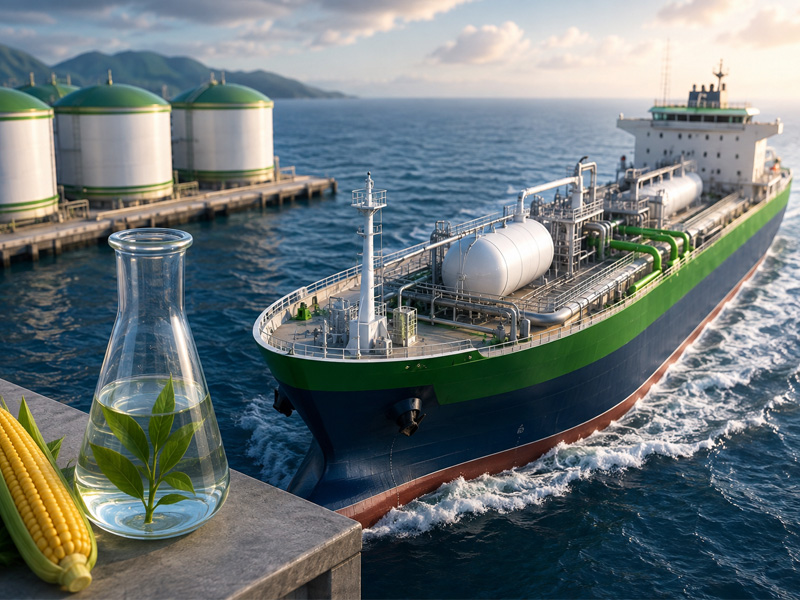
From road fuel to marine fuel, ethanol is gaining attention as shipping companies search for practical ways to reduce emissions and build cleaner energy systems
Singapore, 2 September 2026 – Ethanol has long been associated with road transportation, where it is blended with gasoline to help power cars and trucks. Now, the renewable fuel is beginning to explore a much larger opportunity on the water. Shipping companies, engine manufacturers and fuel producers are examining how ethanol could become part of the next generation of marine fuels.
The global shipping industry is under growing pressure to reduce greenhouse gas emissions. Large vessels consume enormous amounts of fuel during long journeys, creating a strong need for alternatives that can lower emissions without requiring an entirely new transportation system.
Maersk is among the companies exploring this opportunity. The global logistics company has been testing alternative fuels and has placed increasing attention on vessels that can operate with lower-emission fuel options. Since 2021, its new vessel orders have been designed as dual fuel ships, allowing them to use alternative fuels as well as conventional fuel. The company had 19 such vessels in operation when the original report was published.
The scale of marine fuel consumption makes this development particularly important. Depending on the vessel and its size, a large ship can use between 80,000 and 200,000 gallons of fuel every day. Ships traveling long international routes can also be designed to sail thousands of miles before refueling. Finding fuels that can reduce emissions across these journeys could therefore have a significant impact on the shipping industry.
Ethanol is attracting attention because it can be produced from a variety of feedstocks and already has an established production and distribution network in many markets. Industry experts believe this existing foundation could make ethanol an interesting option as shipping companies search for scalable low-carbon fuels.
Engine technology is also moving forward. Swiss marine power company WinGD introduced an ethanol-fueled two-stroke engine for large vessels in 2025 after more than a decade of research and testing. The technology is being developed for both new ships and potential vessel upgrades. WinGD expects to offer an ethanol engine option to customers from 2027.
Another development involves Maersk’s Laura Maersk vessel, which has served as a testing platform for alternative fuel technology. The vessel has tested a dual fuel engine capable of operating with a combination of ethanol and methanol, showing how alcohol based fuels could potentially be used in marine applications.
The interest in marine ethanol is not limited to shipping companies and engine manufacturers. Industry organizations are also working to build the infrastructure and cooperation needed for wider adoption.
The Global Centre for Green Fuels launched the Maritime Ethanol and Methanol Alliance in 2025. The group brings together stakeholders from areas such as shipping, fuel production, engine manufacturing, ports and regulation. Its goal is to help coordinate the development of ethanol and methanol as marine fuels.
One of the biggest challenges is making sure that fuel supply can grow alongside demand. Shipping companies need reliable access to fuel at major ports, while producers need confidence that there will be enough customers to justify investment in production and distribution.
Technology and regulation will also play important roles. Industry participants are continuing to study engine performance, fuel standards and emissions measurement so that ethanol can be used safely and effectively on commercial vessels.
For ethanol producers, marine transportation could open an entirely new market beyond traditional road fuel. For shipping companies, it could provide another tool for reducing the carbon intensity of long-distance transportation.
The transition will not happen overnight. Infrastructure, fuel availability, vessel technology and industry standards all need to develop together. However, the growing interest from major companies and technology providers suggests that ethanol is increasingly being considered as part of the wider conversation around sustainable shipping.
As the maritime sector searches for practical alternatives to conventional fuels, ethanol could be preparing for its next major chapter, moving from the fuel tank of a car to the engine room of the world's largest ships.

Latest News

.jpg "Geotab Puts Sustainable Transportation into Practice")


At Transportation Business Outlook, we believe in the power of knowledge-sharing. Our editorial approach focuses on expert opinions, CEO interviews, market analysis, and success stories, offering readers a comprehensive view of the challenges and opportunities shaping the transportation landscape.
We respect your privacy. The email address you provide will be used solely for subscription purposes and will not be stored or shared.
Subscribe Now