
Opportunity Lost
When Los Angeles was selected to host the Olympic Games, I was immediately excited about how the city would demonstrate autonomous cars, shuttles, and buses. I imagined that the Cal State LA campus could become a playground for autonomous shuttles, where local transportation agencies would bring the vehicles they were considering for evaluation. Indeed, our urban campus has many of the ingredients needed for first- and last-mile demonstrations: a central location, a transportation center served by multiple municipalities, a drive around the campus, stop signs, traffic lights, engineering talent, and more. Over the years, I have floated this idea among shuttle manufacturers, various agencies, and anyone who would say “autonomous.” The Olympic Games are around the corner, and it now seems unlikely that we will demonstrate American trailblazing in this area on our campus or city. There has been considerable resistance, and the technology has not made it easy.

Not as Easy
The robotaxi fleet rollout in Los Angeles has not been smooth either. The cars, all screaming, “I am high-tech and can drive you anywhere,” still operate within defined service areas, although those areas continue to expand. The vehicle’s ability to drive itself is only part of the operation. Fleets also require facilities where vehicles can be recharged, cleaned, and serviced before returning to customers. These activities can affect surrounding neighborhoods. Residents near charging facilities in Santa Monica, for example, have reported nighttime disturbances from noise, lights, and hundreds of vehicles lining up the streets. These experiences bring attention to a practical question: how do we manage the infrastructure and daily operations supporting autonomous fleets?
Concepts Get Deeper
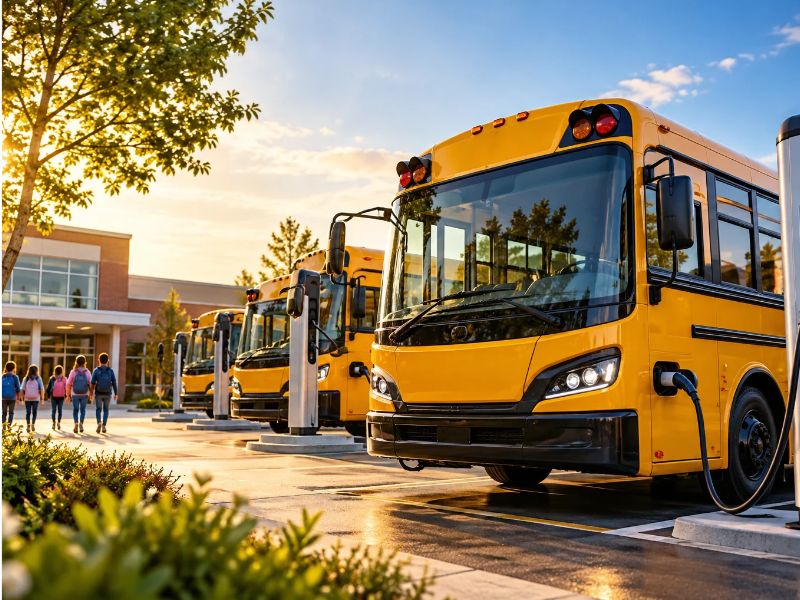
A Finnish company recently introduced management software to help bus depots operate more efficiently. It is based on marrying the Internet of Things within the facility with the autonomous features of buses. During the day, a driver would operate the bus along its route, supported by the increased intelligence of an autonomy-capable vehicle. Upon returning to the facility, the driver would disembark, and the bus would enter a fully autonomous mode supported by the infrastructure. To name a few features of such a system, an arriving bus would be immediately scanned and logged as a returned vehicle. It could drive itself through the wash, proceed to a scanning station to check for damage and repair needs, and move to a charging station where a robotic arm connects it to a charger. Once these chores are complete, the bus could park tightly alongside others while waiting to be called into service the next day. Some people are concerned about job reductions, but with proper training, workers would still be needed to maintain and control the new systems and infrastructure. In this arrangement, bus drivers are retained.
Similarly, during my recent visit to a terminal operating company at the Port of Los Angeles, I observed smart gates where hundreds of trucks are scanned each day upon arrival. The drivers of these drayage trucks use AI-driven software to coordinate their visits. Once the truck, driver, and assignment records are matched, the truck is cleared through the gate and proceeds to a designated location within the terminal to pick up its assigned shipping container. During the visit, I was told that truck turnaround could be completed in under 12 minutes. Time is money—quicker turnaround can allow drivers to make more trips and increase earnings. The terminal also plans to introduce dedicated gates for battery-electric and fuel cell trucks once enough of these clean-technology trucks are in operation.

Autonomous Truck Fleets Are Underway
For the next example, let’s bring up some names. Volvo has adopted a strategy that combines a truck platform designed for autonomy with a technology partner’s autonomous driving system. Its collaboration with Aurora Innovation, Inc. produced the Volvo VNL Autonomous, regularly on display at the Advanced Clean Transportation Expo since unveiling in 2024. In May 2026, Volvo Autonomous Solutions and Aurora announced a new 200-mile route between Dallas and Oklahoma City, delivering freight to customer facilities using the Volvo VNL Autonomous truck integrated with the Aurora Driver. At the time of the announcement, the route operated under supervised autonomy. Such collaborations aim to enhance fleet safety and reliability through integrated autonomous technology, particularly along established freight routes.
Taken together, these developments suggest where Autonomy, AI and the Internet of Things can make a practical difference in fleet management. Real-time monitoring helps operators understand where vehicles are, their condition, and whether they are ready for the next assignment. Predictive analytics can use the accumulated data to help anticipate maintenance needs and plan servicing before a breakdown interrupts operations.
The Next Generation
The rollout of new autonomous technologies may be slowed by their complexity and limited public awareness, highlighting the need for outreach and education. Preparing students for these developments requires an understanding of both the vehicle and the systems supporting its operation. At Cal State LA, the graduate course Autonomous Vehicles and Smart Infrastructure brings these topics together, connecting the technology with practical applications and the challenges of implementation.
Students learn how vehicles sense their surroundings, process information, and control movement. We introduce the SAE levels of driving automation, from Level 0 to Level 5, and discuss the changing roles of the driver and the vehicle at each level. We discuss cameras, lidar, GPS, and other sensors, including their capabilities and limitations. We also examine how artificial intelligence, vehicle connectivity, and information exchanged with infrastructure can support safer and more efficient transportation. These connections are particularly relevant to fleets, where individual vehicles operate as part of a larger system. Through case studies involving shuttles, buses, freight trucks, and other applications, students consider how vehicle data and connected infrastructure can support monitoring, coordination, and reliable operations. Selecting appropriate technology requires attention to operating conditions, computational demands, costs, and data security.
The discussion also extends to safety, failures, ethics, employment, public acceptance and government procedures. I want students to understand both the opportunities and the practical difficulties organizations face when introducing autonomy. Students are encouraged to follow emerging developments and assess them critically. The broader goal is to prepare the next generation of graduates who can enable the implementation of these systems intelligently and contribute to their evolution.

.jpg "Turning AI hype into industrial value: join Asset Performance 2026 in Antwerp")