
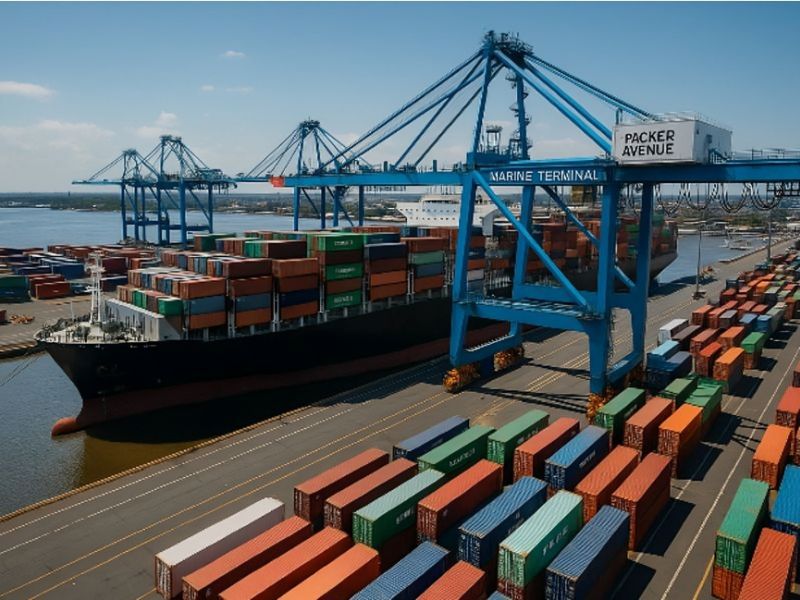
Automation, crane OCR, and AI-driven systems are reshaping productivity, safety, and cargo flow at one of America’s most efficient marine terminals.
Philadelphia, USA, 28 November 2025 – Packer Avenue Marine Terminal, located on the Delaware River in Philadelphia, has become a powerful example of how port automation and digital logistics innovation can redefine terminal operations. Managed by Greenwich Terminals LLC, an affiliate of Holt Logistics Corp., the facility has undergone a decade-long transformation focused on improving speed, safety, and efficiency. Today, it stands as one of the most productive smart terminals in the United States.
With direct access to national distribution routes and the capability to handle ships up to 16,000 TEU using seven modern quay cranes, the terminal has continued to evolve to meet growing demand. But achieving sustainable growth required one major shift, embracing advanced technologies that could solve operational bottlenecks and support future-ready supply chain modernization.
Automation Unlocks Growth
Several years ago, Packer Avenue Marine Terminal identified its gate operations as a limiting factor. Manual processes restricted throughput to around 1,200 gate moves per day, threatening long-term expansion. To overcome this, the terminal partnered with ABB to introduce automated gate systems and advanced crane OCR technology, two major drivers of container handling efficiency in modern ports.
According to John Burleson, General Manager of Greenwich Terminals, gate transaction times dropped from around ten minutes to as little as two minutes and thirty seconds. This improvement enabled faster truck movement, reduced congestion, and enhanced overall port productivity.
The transition also significantly improved safety. Employees once required to work on foot near moving trucks were moved into office-based roles, protected from extreme temperatures and weather conditions. This boosted morale, improved working conditions, and strengthened productivity, key goals in modern terminal workforce optimization.
Importantly, the introduction of automation in terminal operations did not eliminate jobs. Instead, labor was strategically redeployed to support critical areas of the operation, enhancing fluidity and helping the terminal meet rising demand.
Advancing to Crane OCR
Building on the success of gate automation, Packer Avenue Marine Terminal implemented ABB’s crane OCR solution to elevate accuracy and accelerate vessel operations, an essential advantage for terminals aiming to lead in marine terminal innovation.
Using quay crane cameras, the system recognizes containers during loading and discharge, sending real-time data directly to the terminal operating system (TOS). The MatchMaker module matches each container with the correct yard truck, enabling complete tracking from ship to storage.
This real-time synchronization enhances planning, improves accuracy, and provides customers with timely updates on container location key benefits in today’s digital supply chain environment.
Another feature, ABB’s QuayPro module, offers a live virtual stow and identifies discrepancies instantly. This allows for quick corrections, faster BAPLIE generation, and shorter turnaround times, supporting the terminal’s goal to move ships efficiently and strengthen port turnaround performance.
QuayPro also allows teams to replay operations for training and ongoing process improvement, critical for terminals aiming to remain competitive in an era of AI in port operations.
The Power of Partnership
Alan Dow, Assistant General Manager at Greenwich Terminals, notes that ABB’s technology has been instrumental in enhancing port performance. Moving from manual to semi-automatic processes has been “game-changing,” leading to greater accuracy, smoother workflows, and improved terminal efficiency.
Burleson echoes this sentiment, emphasizing how strategic technology adoption helped Packer Avenue Marine Terminal expand into an 800,000 TEU facility despite its compact footprint, a testament to successful port digital transformation.
Packer Avenue Marine Terminal’s journey underscores the role of innovation in modern logistics. By integrating automation, OCR, AI-driven insights, and advanced digital tools, the facility has strengthened its operations and positioned itself as a leader in next-generation port technology.
Through strong partnerships and a commitment to continuous improvement, the terminal continues to set new standards for port automation excellence, safety, and performance, driving long-term growth and resilience in the evolving world of global trade.

Latest News



At Transportation Business Outlook, we believe in the power of knowledge-sharing. Our editorial approach focuses on expert opinions, CEO interviews, market analysis, and success stories, offering readers a comprehensive view of the challenges and opportunities shaping the transportation landscape.
We respect your privacy. The email address you provide will be used solely for subscription purposes and will not be stored or shared.
Subscribe Now